Refuse to Die to the Status Quo

Photo by John-Mark Smith on Pexels.com

Do you remember going to Blockbuster Video (or whatever video store was in your community) on Friday Nights? Even my small community of Sheakleyville, PA, had a video rental store (which is saying something.) Friday nights were full of possibilities as you browsed the videos to see what you might be in the mood to watch.

The champion of video stores was Blockbuster, with its ubiquitous blue-and-yellow branding. They ruled the video store universe. There were other competitors, of course, but no one could knock off the king. 

Enter Marc Randolph and Reed Hastings. In the mid-1990s, they grew tired of the late fees that Blockbuster charged and the challenge of watching movies in a day. They dreamed of a better alternative. In 1997, Netflix was born as a mail-order service where you kept the DVDs as long as you needed and didn’t pay late fees. While Netflix’s business saw some modest success, it was never really profitable. In 2000, Randolph and Hastings offered to sell the company to Blockbuster for $50 million. Blockbuster executives laughed them out of the room.

In 2024, Netflix earned $39 billion. Blockbuster, which once had 9,000 stores, is down to one remaining store. What set Netflix and Blockbuster apart was that Blockbuster was very slow to adapt. At the same time, Netflix was willing to disrupt its own business model to discover and create a better, more successful one (hello streaming!). 

Within the church, we love stability and the status quo. For many, stability brings comfort and reminds us that God never changes. The challenge for the church is that we live in a rapidly changing world. These changes are disruptive to the church and can feel threatening. They are also opportunities to adapt and change our methods to meet the needs of our communities and point people to a saving relationship with Jesus Christ. If we remain committed to the status quo, we will go the way of Blockbuster and others who refused to adapt.

As leaders in the church, we must disrupt ourselves by asking good (and difficult) questions.

-“If our church ceased to exist, would anyone in our community notice?”
-“How much more effective would we be if we focused on the one thing we did best?”
-“How do we create a church community that reaches the unchurched?”
-“Do we love Jesus enough to do whatever is necessary to share that love with our neighbors?”

If we do not disrupt ourselves by asking good questions and adapting, the rapidly changing world will disrupt what we do and we will be slow to respond. Let us not die to the status quo, and instead do teh work to share God’s love in ways that bring life and transformation to our churches and communities.

(thanks to this article for some additional background on Blockbuster and Netflix. https://fortune.com/2023/04/14/netflix-cofounder-marc-randolph-recalls-blockbuster-rejecting-chance-to-buy-it/)

Posted in Leadership | Tagged , , , , , , , , | Leave a comment

Live As Those Prepared to Die

I was up at 5:00 a.m. this past Saturday to prepare for the day, including Abbie’s graduation, a softball tournament, and a soccer match. What really woke me up was a message from a congregant alerting me to the tragic death of another congregant in a car accident. I’ve known this person for 25 years in the Avenue family. We had some inside jokes, especially about Sundays when she was the liturgist and how difficult biblical names fell frequently to her. This person was well-respected within the community and made a significant impact as a lifelong educator in our local school district.

Sitting in the bleachers at Caesar Rodney High School that morning, I prayed silently for her family and friends. I prayed for our church and our Milford community. Death is hard enough to deal with, but unexpected death is so brutal because it is that– unexpected. How do we, as Christians, handle death when it is unexpected, tragic, or happens to someone far too young?

Christians Embody God Who Comforts and Offers Peace: In the ancient book of Job, the namesake loses his family and property to a tragedy. He has a group of friends who come and sit with him in silence for seven days. This is good. It’s not comfortable, but sitting with those who are grieving is necessary. Our presence is a healing balm. If you know Job’s story, you know that the “friends” end their silence and begin trying to tell Job “why” this tragedy happened. They should have stayed silent! It is often impossible to tell someone why tragedy happens. We don’t need to offer platitudes (“God needed another angel,” etc.), we need to offer our presence full of the Spirit’s presence to comfort.

Christians Weep With Those Who Mourn: In the Gospel of John (ch. 11), Jesus’ good friend Lazarus becomes sick and dies. Mary and Martha believe that Jesus could have healed their brother. For reasons that only God knows, Jesus delayed going to Lazarus, and he died. As Mary and Martha confront Jesus, we see that Jesus weeps. While Jesus is fully divine, he is also fully human, meaning he feels and experiences the entire range of emotions you and I feel. In this moment of grief, Jesus weeps. Pastor Andy Stanley said, “Great grief is a faithful indicator of great love.” We are permitted to weep and grieve when those we love pass on to the next life.

Christians Live Ready to Die: There is the adage that death and taxes are the only two sure things in life. The reality of our mortality should cause us to live as those who are prepared to die. In Luke 13, Jesus tells of a current event (to him) of the Tower of Siloam collapsing and killing eighteen people. The point that Jesus is making is that we do not know when death will come, so we should repent of our sins and live each day fully with God. If we live as those who are prepared to die, then we can die as those who go forth to live.

Christians Grieve Differently: Paul writes in 1 Thessalonians 4 that Christians should not grieve like the world, which has no hope. We have hope of resurrection and eternal life in Christ, which impacts how we grieve. We will still weep and terribly miss our loved ones. But we have hope that through our faith in Jesus, death does not have the final say. There is life after life and death.

Tragedies are bound to happen regularly in a sinful and broken world. As Christians, we can develop a theology of death and grief that does not lose hope even as we miss the ones we love. Above all, we pray for God’s peace, which passes all understanding, to fill the hearts of those who mourn.

*I shared this post in the Avenue United Methodist Church Midweek Newsletter on June 11, 2025

Posted in Bible Thought, Death | Tagged , , , , , , , | Leave a comment

The First Sunrise Service

[Sermon from sunrise service at Avenue United Methodist Church on April 20, 2025]

This morning, you intentionally decided to get up, get dressed, and come to church. We don’t usually hold 6:15 a.m. worship services. Why did you come this morning? You may not even typically wake up on a Sunday at this time of day. I once heard that the son of a preacher asked him, “Dad, why can’t we have sunrise service on Wednesday evening?”

Many of us came this morning because it is our Easter tradition. Some of us came because we want to celebrate Christ’s resurrection. Others of you have come with reverent hearts, much like Mary Magdalene and the other women did when they went to the tomb on that first Sunrise Service.

The Gospel of John tells us that “early on the first day of the week, while it was still dark, Mary Magdalene went to the tomb.” We know from the other Gospel accounts that she and some other women went to finish the burial process that was started on Friday before sunset. The Sabbath began at sunset that night, delaying the women from completing the task.

When Mary got to the tomb, she saw that the stone had been rolled away. The other Gospel accounts describe an earthquake shaking the countryside, soldiers passing out, and the stone rolling away. Matthew tells us that at Jesus’ resurrection, people who had previously died came back to life and went into Jerusalem and “appeared to many people.” Creation was declaring and groaning for resurrection and redemption that is possible through Jesus. That first sunrise service was impressive.

I want to examine a couple of things about how we are called to live as Easter People in 2025.

FEAR IS TURNED TO HOPE

In the Gospel of Matthew, an angel appears to the women, sitting on the stone that was previously in front of the tomb. The angel said to them,

“Do not be afraid, for I know that you are looking for Jesus, who was crucified. He is not here; he has risen, just has he said.”[1]

The world of the women and the disciples had fallen entirely apart a few days before. Once, they followed Jesus and were amazed by his teachings, his miracles, and his compassion for others. They had to be wide-eyed at the procession into Jerusalem on the previous Sunday. Just three days ago, Jesus was betrayed by Judas, arrested, beaten, hung on the cross, and laid in the tomb. The hope that Jesus embodied seemed to die with him.

The disciple’s world had been turned upside down. The angel told them to not be afraid. Why? Because Jesus was alive. Through the resurrection, Jesus will make right all the wrongs; Jesus will heal all that hurts; Jesus will turn fear into hope.

SORROWS ARE TURNED TO JOY

In the Gospel of John, Mary encountered the resurrected Jesus but did not recognize him until he called her by name. At that point, Mary recognized the voice of her Shepherd, her leader, her rabbi, her friend, and her Lord. It was a sound that Mary had to have heard hundreds of times before. In that moment, I imagine that all Mary’s sorrow was turned to joy. Jesus was not dead. He was not missing. His body had not been stolen. Jesus was alive and standing before her. After receiving instructions, Mary went to tell the other disciples, “I have seen the Lord!”

Do we recognize the voice of our Savior and Lord? Do we recognize the voice of our Savior? There are many sorrows in this world; there are many trials, and yet, in the midst of them, Jesus calls us by name. Jesus knows us. Jesus loves us. Jesus calls to us. He wants to turn our sorrow into joy- because He is alive and at work in our lives. The resurrection turns our sorrow into joy because Jesus is alive!

EASTER IS THE START OF OUR WORK

Jesus told Mary to tell the other disciples that he was alive and to wait for him in Galilee. Later on that first Resurrection Sunday, the resurrected Jesus appeared to his disciples and told them to receive the Holy Spirit. Jesus tells them:

“If you forgive anyone’s sins, their sins are forgiven. If you do not forgive them, they are not forgiven.”[2]

Upon seeing the disciples after the resurrection, Jesus equipped them for ministry with the Holy Spirit and commissioned them to forgive the sins of others. Now, we know that this ministry didn’t fully go into effect until Forty Days later, at Pentecost, when the Holy Spirit fell on the disciples in the Upper Room. They went and proclaimed the resurrection, and 3000 people put their faith in Jesus.

As Easter People who have put our faith in Jesus Christ, we have a calling! We are called to proclaim the hope of the resurrection that takes away our fear. We are called to proclaim that sorrow has been turned to joy. We are called to preach that Jesus is not dead, but is alive.

As we prepare to go about our day and celebrate Easter, remember that our celebration is not contained to just a day. We are Easter People every day! Let us not live in fear, but in the hope of Christ. Let us be people of joy because of what God has done for us. Let us join in the redemptive work that God is doing and point other people to God’s love and grace. Christ is Risen!


[1] Matthew 28:5-6, NIV.

[2] John 20:23, NIV.

Posted in Uncategorized | Tagged , , , | Leave a comment

GOOD FRIDAY | Leave It At The Cross

[Good Friday Meditation From Avenue United Methodist Church, April 18, 2025.]

On Holy Thursday, we gathered to remember how Jesus humbled himself and took the position of a servant, washing the feet of his disciples. Tonight, we will recall how Jesus humbled himself even further by dying a criminal’s death on a cross.

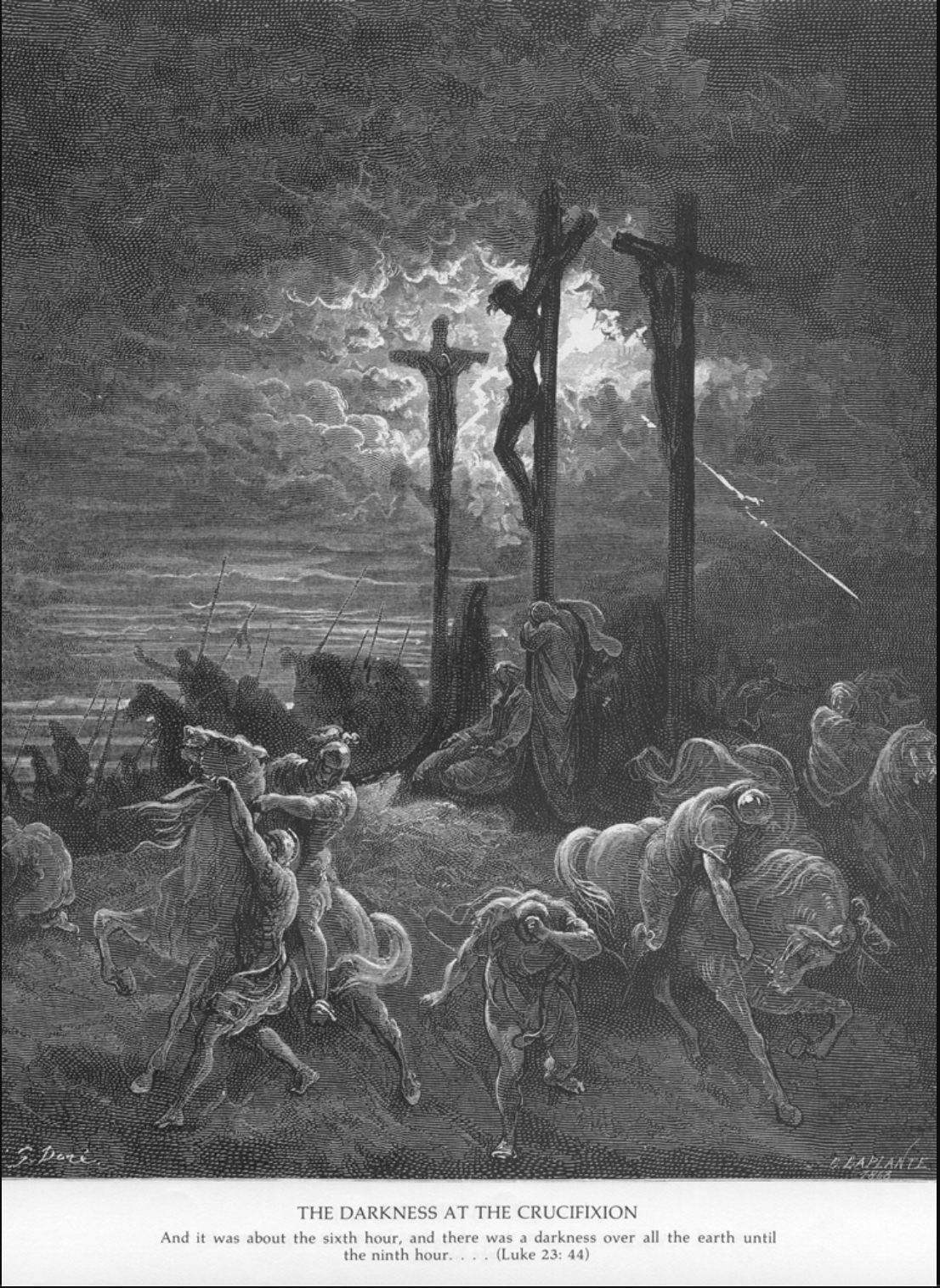
Today is a challenging day. As Christians, we are invited to reflect on Jesus’ death on the cross. Thinking about death is hard enough, but reflecting on the kind of death that Jesus endured is even harder.

There was a seminary that created a series of online advertisements for an upcoming course on atonement theories, which are images in the Bible that tell us what Jesus did on the Cross. Facebook would not allow the ads on their page because they said that the Cross was an instrument of violence. In a blog post, the seminary actually agreed with Facebook, stating that the cross was an instrument of death. But it is on that cross that sin and death are ultimately defeated.

Tonight, we gather to consider the cross of Jesus and reflect on what Jesus took on when he was nailed to it.

In John 19:16-18, the gospel writer records:

So the soldiers took charge of Jesus. 17 Carrying his own cross, he went out to the place of the Skull (which in Aramaic is called Golgotha). 18 There they crucified him, and with him two others—one on each side and Jesus in the middle. [1]

If you grew up in the church or have seen The Passion of Christ or another similar movie, you likely have an image of Jesus carrying his cross. When we think about it, it is an intense form of degradation. It would be like someone holding their own electric chair or injection needle.  Jesus carries his cross to Golgotha for the Roman soldiers to crucify him there.

Judaism, as a religion, was based on a sacrificial system dating back to the days of Genesis. There were prescribed sacrifices that had to take place based on the sins in our lives. There were constant sacrifices made at the tabernacle and the Temple to atone for the people’s sins. The priest would lay their hands on the goat or bull (or other sacrifice) and place the person’s sins on the animal. Then they sacrificed it. This went on for hundreds of years.

The writer of Hebrews states that “For it is impossible for the blood of bulls and goats to take away sins.”[2]

The writer of Hebrews continues:

“Every priest stands daily at his service, offering repeatedly the same sacrifices, which can never take away sins. But when Christ had offered for all time a single sacrifice for sins, he sat down at the right hand of God…for by a single offering he has perfected for all time those who are being sanctified.”[3]

When Jesus was crucified on the cross, the NT writers, under the inspiration of the Holy Spirit, understood Jesus’ death to be the final, perfect sacrifice for our sins. The sacrifice that paid the complete cost for our sin. Our sin, and the sins of the world, were placed on Jesus and destroyed at Jesus’ death, so we are forgiven and sanctified.

The simplest directions on what it means to start following Jesus come from Paul’s letter to the Romans. He writes,

“If you declare with your mouth, ‘Jesus is Lord,’ and believe in your heart that God raised him from the dead, you will be saved.”[4]

When we declare that Jesus is Lord and that God raised Jesus from the dead, we repent of our sin. Repenting is a 180-degree turn away from our sin and a turn to Jesus. In turning to Jesus, the sins that we carry are placed upon Jesus and nailed to the cross. We are forgiven, and our sins are remembered no more. Jesus became our sin. Paul writes in 2 Corinthians 5,

“God made he who had no sin to be sin, so that we might become the righteousness of God.”[5]

Jesus carried the Cross so we might be free from our sins. God’s love for you, me, and all of creation enabled Jesus to become sin so that we might be saved.

The question I want to ask tonight is this: Are you still carrying your sin? Are you still carrying your burdens? Have you asked Jesus to take on your sin so that you might be forgiven and saved?

On Tuesday, September 8th, 2015, a British Airways jet caught fire at the Las Vegas airport, sending smoke billowing into the air, after suffering what the pilot described as a “catastrophic failure” of the left engine. The plane—a Boeing 777 heading from the U.S. city’s McCarran airport to London Gatwick—could be seen with flames around its fuselage.

The pictures of a burning jetliner in Las Vegas were certainly riveting. But as the plane burst into smoke and flames, some observers saw something even more startling: People stopped during their evacuation to grab their luggage. Authorities are certainly concerned about planes bursting into flames, but they’re also worried that we might risk our lives to grab our carry-on bags.

So what’s the big deal with grabbing one carry-on bag? The FAA requires planes to be evacuated within 90 seconds, but as a Chicago-based air traffic controller wrote:

Let’s say the average delay time per bag is 5 seconds. This includes the time needed to reach up to open the overhead compartment, pulling the bag down, and the extra delay hauling it through a crowded aisle. If half of the 170 people on board Flight 2276 took the time to take their bag the evacuation would have taken an additional 7 MINUTES longer than necessary. Imagine being the last one to exit the smoke-filled cabin, knowing that your one-minute evac time is now over 7 minutes!

One veteran pilot with a major U.S. airline said, “We’re always shaking our head. It doesn’t matter what you say, people are going to do what they do.” Or as one blogger summarized this news story: “People love their carry-ons more than life itself.”

For many of us, we love carrying our burdens. We love carrying our sins. We hold on to them as we have allowed them to shape our identity. We have become comfortable with our sin- and even the effects of our sin in our lives and on the relationships we have with God and others.

Jesus went to the cross to take on our burden. He went to the cross to take on our sin- to become sin so that we might be forgiven and saved. We have to let go of our baggage, our sin; we have to confess and repent so that Jesus can take our baggage for us.

The Good News of Good Friday is that Jesus’ death lifts the burden and frees us from our sin. What do you need to leave at the Cross? What baggage are you holding onto that is preventing you from experiencing the life that God offers through Jesus Christ? Leave it at the Cross.


[1] The New International Version (Grand Rapids, MI: Zondervan, 2011), Jn 19:16–18.

[2] Hebrews 10:4, NIV.

[3] Hebrews 10:11-12, 14, NIV.

[4] Romans 10:9, NIV.

[5] 2 Corinthians 5:21, NIV.

Posted in Cross, Good Friday, Lent | Tagged , , , , , | Leave a comment

Break My Heart for What Breaks Yours

There is a worship song by Brooke Fraser and Hillsong United called “Hosanna.” It has been one of my favorite songs since it first came out in 2007. The song echoes the Triumphal Entry when all the people shouted “Hosanna!” at the arrival of Jesus in Jerusalem. If you remember that after Jesus entered Jerusalem, he wept over the city (Luke 19:41-44). In the bridge of the song, Fraser sings,

“Heal my heart and make it clean,
Open up my eyes to the things unseen.
Show me how to love like you have loved me.
Break my heart for what breaks yours.
Everything I am for Your Kingdom’s cause
As I walk from earth into eternity.”

“Break my heart for what breaks yours” became a prayer of mine after hearing that song. There is so much in the world that I can be unmoving to, but God is moved because God loves each of us. I am called to express my love for God by how I love my neighbors- all my neighbors. To do that, I must have empathy and compassion for the situations they find themselves in. My heart must break when God’s heart breaks because I am learning to love my neighbor the way that God loves them- and me.

As we go about our days, as we pray and follow Jesus, our Master- may our hearts be broken by the things that break God’s heart because we are learning to love the way God loves.

Posted in Bible Thought, Worship | Leave a comment

Finding Hope In Struggles

“I will repay you for the years that the swarming locust has eaten, the hopper, the destroyer, and the cutter, my great army, which I sent against you.” 
Joel 2:25

“Even when I don’t see it, you’re working.
Even when I don’t feel it, you’re working.
You never stop; you never stop working
You never stop; you never stop working.

-Waymaker, by the band Leeland

We are a week from Thanksgiving, from the turkey, the stuffing, the pumpkin pie, the football, and the food-induced comas. For some in our community, Thanksgiving is a time for family and friends to thank God for the blessings in our lives. Life is not a Norman Rockwell painting; our lives feel pretty good.

Others struggle with Thanksgiving (and the holidays, in general). Whether it is toxic family situations, a lack of financial provisions, troubles at work, or health concerns, it can be challenging to have an attitude of gratitude.

The prophet Joel tells about God’s plan to redeem and restore Israel after being in exile. The country is in ruin. The people need to repent of their sins. Amidst all that, God promises to “redeem the years the locust stole.” In other words, God will bring Israel through the difficult, tragic, and even horrific years to plenty where they will not be put to shame again. This is quite the reversal.

These words were spoken to Israel while in exile. The restoration had yet to happen. They had to believe it would happen even though everything around them screamed that God had forgotten them. They had to think God was working even though they could not see it.

During this season of Thanksgiving, let us remember that God is at work in our lives even when we cannot see it. ESPECIALLY when we cannot see it. Let us thank God even when we are going through difficult times so that the better times are all the better.

Posted in Bible | Tagged , , , , , , , , , , | Leave a comment

The Integrity of Our Witness

In my message at Avenue last week, I said that apprentices (followers/disciples) of Jesus Christ will do what Jesus did. Even a cursory reading of the Gospels will give us clues about what Jesus did during his lifetime: proclaim the Gospel, call people to repentance, care for the poor, heal the sick, give the thirsty a drink, clothe the naked, free the oppressed, forgive sins, and bring hope in a hopeless world. In short, Jesus’ ministry was summed up with love. A life shaped by Jesus should be becoming more loving. John Mark Comer writes, “love is the acid test of spiritual formation.”

Getting this right is vital to our witness about Jesus Christ. 

In a 2023 survey by the Barna Group, 71% of respondents said they had a favorable view of Jesus (including 40% of those claiming no faith.) Yet only 51% of respondents have a favorable view of Christianity (21% of the “nones” have a favorable view), and 47% said they have a favorable view of the local church (22% of the “nones”). People, including non-religious people, do not have a problem with Jesus. They have a problem with the Church. 

There is a ton of research, including books by Dan Kimball and David Kinnaman, that shares the emerging generation’s views on the Church. They believe that the Church is anti-science, judgmental, repressive, and too political, to name a few. There is research available (also here) stating that Christians are more susceptible to conspiracy theories. People exploring Christianity may be more likely to hear what we are against than experience the love of Christ.

When we claim to follow Jesus but espouse conspiracy theories (Covid-19, Qanon, etc), it affects our witness. When we elevate politicians and celebrities whose morality and lives do not line up with the example of Christ, our witness is nullified. If we speak of migrants, people of different ethnicities, and those living in different countries in any way less than that they are people created in the image of God, our witness is not for Christ. When we claim to follow the Prince of Peace, but our words are words of violence (and maybe our actions, too) then we lack integrity in our witness. When we would rather punch back than turn the other cheek, or allow for bitterness rather than forgive or hating our enemy rather than loving them, we have failed in our witness for Jesus.

We have to get our witness right. Our children and grandchildren need to see Jesus in us and experience Jesus through us. If we want to see them come to faith, our words, actions, and deeds must reflect the love, grace, mercy, and peace of Jesus. We must remove barriers to the Gospel rather than build walls that prevent us from offering Biblical hospitality that points to Christ. There must be integrity in our witness where our lives reflect the One we profess to follow.

As we grow in our apprenticeship with Jesus, may our witness be consistent and true as we share the love of God with those around us. May our lives reflect the love of Jesus for all people. May our choices mirror God’s Kingdom to the world around us.

Posted in Discipleship | Tagged , , , , , , , , | Leave a comment

Formed By Love

“Love is the acid test of spiritual formation.”
-John Mark Comer

Spiritual formation is the act of allowing God to shape us so that our lives look like the life of Jesus. Spiritual formation does not miraculously happen. It takes place over years of being with Jesus and doing what Jesus says as the Holy Spirit shapes us. Spiritual formation is not a “Christian” idea. We can look at a person’s life, beliefs, words, and actions and see what has shaped them. Social media, politics, celebrity, philosophy, and religion are some forces that shape us. 

As apprentices of Jesus, love should be the thing that sets us apart from those who do not follow Jesus. In Galatians 5, the Apostle Paul writes that the Fruit of the Spirit, the evidence of the Holy Spirit at work in our lives, is Love, Joy, Peace, Patience, Kindness, Gentleness, Goodness, Faithfulness, and Self-Control. These characteristics all flow out of our ability to love. In 1 Corinthians 13, Paul writes that we can do all sorts of great things for the Kingdom, but if we do not love, we are nothing.

If we are to live as apprentices (disciples) of Jesus Christ, we must love as Jesus loved. Our lives should bear fruit that points people to Jesus. If we are to live as Jesus lived, then others will experience the love of Christ through us. Love should be formed in our lives because of Jesus.

Brothers and sisters, as our world becomes more polarized, let us live such good lives that the world may glorify God (1 Peter 2:12). Let us sow love generously as we follow in the footsteps of our Master.

Posted in Uncategorized | Tagged , , , , | Leave a comment

God Remembers

The other day I read the story of Hannah in the Bible. It’s found in 1 Samuel, chapter one. Hannah loved God but was childless. We’ve discussed this before, but being childless in ancient culture was seen as a curse. Like some of the other barren women mentioned in the Bible (Sarah, Elizabeth, etc), God was at work behind the scenes. 

In 1 Samuel 1:19-20, the author writes this, 

“Elkanah knew Hannah his wife, and the Lord remembered her. And in due time Hannah conceived and gave birth to a son, and she called his name Samuel, for he said, “I have asked for him from the Lord.”

The phrase that sticks out is that “the Lord remembered her.” Did God forget about Hannah? No, for God cannot forget. Did God not hear Hannah’s prayers for a child? God certainly heard Hannah’s prayers. By “remembering,” God is acting according to his promises. 

We had a Church Council meeting last night, and Pastor Dan gave his report to those present. As you likely know, Pastor Dan has a great ministry at five local nursing homes. When he walks into a nursing home room or the home of a shut-in, he is a visible reminder to the person he is visiting that “God remembers” and is faithful in all His promises.

It’s not just Pastor Dan. Each of us carries the presence of God with us (that Holy Spirit that Pastor Neyda preached about on Pentecost Sunday). When we visit the sick, we are reminded that “God remembers.” When we pray with someone, our prayers communicate that “God remembers.” When we share our hope and faith with someone at the end of their rope, our presence communicates that “God remembers.”

Perhaps you need to hear it as you read this post: God will never leave or forsake us (Deuteronomy 31:8). We can be encouraged that God is with us and faithful to His promises. God remembers.

Posted in Bible Thought | Tagged , , , , | Leave a comment

Celebrating Those Who Pass Along the Faith

Sunday is Mother's Day, and the Bible is filled with stories of women essential to the Gospel. Jesus' genealogy contains the names of five women central to his story and mission: Tamar, Rahab, Ruth, Bathsheba, and Mary. Mary Magdalene was the first to proclaim the Good News of the resurrection. Paul tells us about Junia, who he describes as being "outstanding among the Apostles" (Romans 16:7). Scholars believe that Junia may have been one of Paul's benefactors and carried Romans to its recipients, which means she likely would have helped to have explained Paul's writings. Paul recognized that Timothy's grandmother (Lois) and mother (Eunice) were essential in developing his faith.

My faith story is filled with women who have passed along the Good News of Jesus to me. My grandmother, Gertrude, prayed for me every day. My mother, Esther, along with my Dad raised my sister and I to put our faith in Jesus. Sunday School teachers like Janet Hartley and Lois Cashdollar taught me the story of the Bible on the flannelgraph. Mary Lynn (aka ML) was always sure to check in on me and the condition of my walk with God. I see Jesus in Andrea, my wife, as she regularly shows me what love, grace, compassion, and forgiveness look like. My daughters, Abbie and Chloe, bring me so much joy and make me want to be a better Dad and person.

My faith would not be what it is without the impact of the women in my life who have answered the call to be the hands and feet of Christ to me and so many others. Past and present, Avenue is filled with many women who have shared their faith with us. As we celebrate mothers and all the women who helped shape our lives, let us thank God to those who have imparted their faith into our lives.
Posted in Uncategorized | Tagged , , , , , | Leave a comment